Arriving at Lisbon Airport: Terminals, Border Control and the Metro
What a US traveler can expect landing in Lisbon: the EU's entry/exit system at the border, what to confirm about the terminals, how the Metro describes the ride into the city, and where to look for trains to Porto and the Algarve.


A US traveler landing in Lisbon meets two systems in quick succession: the European Union’s border registration, which changed in 2025 and 2026, and a metro station at the airport. This guide covers both, plus what to confirm about the terminals and how to continue to Porto or the Algarve.
This guide is reported, not experienced. It is built from the EU’s official Entry/Exit System pages, Metropolitano de Lisboa and CP (Comboios de Portugal), all read on November 15, 2026. One source could not be read: the airport’s own website returned a security check instead of its pages. Where that leaves a gap, the guide says so and tells you what to look up. It gives no fares or timetables.
The terminals: what could and could not be confirmed
VINCI Airports (checked November 15, 2026) lists ANA Aeroportos de Portugal as the concessionary entity for Lisbon Airport, wholly owned by VINCI Airports. The airport’s website, lisbonairport.pt, would not load for this guide, so nothing here about the terminals comes from the airport itself.
What an official source does confirm: Metropolitano de Lisboa’s airport page says to step outside Terminal 1 from Arrivals and follow the signs to the Metro entrance, a short covered walk away. That locates the Metro for an arriving passenger. It does not say which terminal a departing flight uses.
Before your trip home, check these on the airport’s own site and with your airline:
- Which terminal your departing flight uses. Your booking or boarding pass should show it.
- How many terminals the airport lists, and how to get between them, with how much time the airport says to allow.
- Where the Metro, buses and taxis are relative to the terminal you need.
Border control under the EU’s entry/exit system
Portugal is one of 29 European countries using the Entry/Exit System, or EES, according to the EU’s official EES site (checked November 15, 2026). The site describes it as an automated system that registers non-EU nationals traveling for a short stay each time they cross the external border of those countries. It applies to travelers who need a short-stay visa and to those who do not, which includes US passport holders visiting visa-free.
In force on the date checked. The European Commission’s EES page says the system started progressively on October 12, 2025, and became fully operational on April 10, 2026, when it replaced the stamping of passports.
Announced, not in force. ETIAS, the EU’s separate travel authorization for visa-exempt visitors, had not started. The official ETIAS site said on November 15, 2026, that the system was “currently not in operation” and that no applications were being collected. It said the EU would announce the start date several months ahead. On that date there was nothing to apply for.
What the EES site says happens at the desk
The site’s page on how the EES works separates two cases:
- Your first crossing since the system started. You provide your personal data, and passport control officers take a photo of your face, scan your fingerprints, or both. That goes into a digital file. Your passport is not stamped.
- Later crossings. Your photo and fingerprints are already on file, so officers only verify them, which the site says takes less time. With a biometric passport you may be able to use a self-service system where one is available.
“Short stay” is defined as up to 90 days within any 180-day period, counted as one period across all the countries using the system.
The optional app
The EU also publishes a “Travel to Europe” mobile app. The site says it is optional, is for travelers with biometric passports, and can be used within 72 hours before arriving or leaving. For Portugal, on the date checked, it said the app supports the entry questionnaire only; Sweden was the one country listed with fuller functions. The site says the app does not replace the border check.
The EES pages read for this guide describe no application or payment that a traveler must complete before the trip. That is a description of what the official pages say, not immigration advice. The EU’s site describes registration as taking place each time a traveler crosses the external borders of the countries using the system. If you connect to Lisbon through another of those countries, ask your airline where your border check takes place.
The Metro into the city
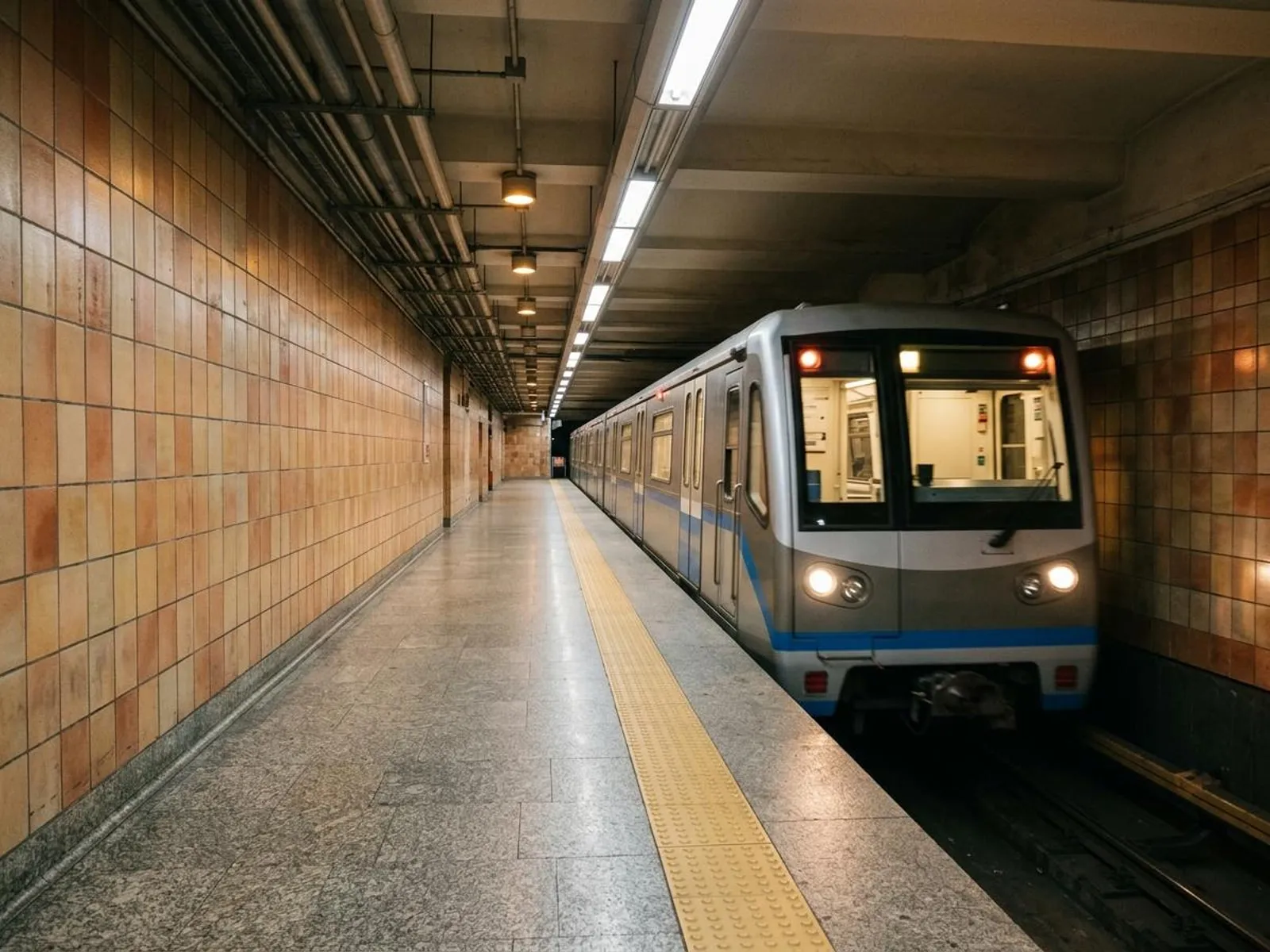
Metropolitano de Lisboa’s Aeroporto station page (checked November 15, 2026) puts the station in the airport building, in the arrivals area. The same page shows a live service status; look at it before you travel.
Paying. The Metro’s airport page says no ticket is needed: you can tap a contactless bank card, phone or smartwatch at the gate, one card per person. Its tickets page describes the alternatives, including the navegante occasional card for occasional riders, single and 24-hour tickets, and prepaid travel credit, sold at ticket machines and ticket offices.
Tap in and out. The Metro’s rules page says validation is mandatory at both the entry and exit gates, and that special access gates are reserved for certain passengers, including those with baby strollers or large objects. It also says objects that may affect other passengers’ safety or comfort may not be carried.
Changing lines. The Metro’s airport page lists where to change for central destinations:
| Heading for | What the Metro’s airport page says |
|---|---|
| Parque das Nações | Oriente, no transfer listed |
| Gulbenkian museum | São Sebastião, no transfer listed |
| Parque Eduardo VII (Marquês de Pombal station) | Change at Saldanha |
| Praça do Comércio (Terreiro do Paço station) | Change at São Sebastião |
| Rossio, Baixa-Chiado, Cais do Sodré | Change at Alameda |
The Metro gives approximate trip times on that page, including 18 minutes from the airport to Saldanha, which it labels the city center, and says they may vary (Metropolitano de Lisboa, checked November 15, 2026).
Hours. The Metro’s timetable page gives a daily opening and closing time; it is not a round-the-clock service. If your flight lands late at night or very early, check those hours against your arrival before counting on it.
Buses and taxis
The Metro’s Aeroporto station page lists bus routes 705, 722, 744 and 783 at the station (checked November 15, 2026). Carris, the city bus operator, lists those routes and their end points on its routes page. Check the stops, the timetable and Carris’s luggage rules with Carris before choosing a bus.
For taxis, the place to look is the airport’s own ground-transport page, which could not be read for this guide. Check there for the official rank and what the airport says about fares and ride-hailing pickups.
Continuing to Porto or the Algarve
CP, Portugal’s national rail operator, describes its Alfa Pendular service as running between Braga and Faro and from Lisbon to Porto, and its Intercidades service as linking the main cities from the Minho region to the Algarve (both checked November 15, 2026). Faro is in the Algarve.
Those pages do not name the Lisbon stations. Look up your train in CP’s booking tool to see which Lisbon station it leaves from, then plan the Metro ride from the airport to that station. Leave your own margin between a transatlantic arrival and a booked train; neither CP nor the airport promises that connection.
If you are flying onward instead, and the flights are on separate tickets, sort out the baggage first: see checking the bag-transfer arrangement before combining tickets.
First-hand note
No first-hand note yet. This guide is reported from the official sources linked above.
Planning the Lisbon part of the trip
For ideas on what to do once you are in the city, see the Lisbon page on Bucketlist Experiences. Plan those outings separately from the arrival steps above.
For the other parts of a Lisbon trip: Travel Tutor covers the UK ETA and the EU’s entry schemes for US travelers; Railway Reviews covers Lisbon’s stations and train routes; Hotel Hacker covers Lisbon hotels and what to check; and RESTED covers a month in Lisbon without a car.
Common questions
Does a US citizen need to apply for anything before flying to Lisbon? On November 15, 2026, the EU’s ETIAS site said ETIAS was not in operation, and the EES pages described registration at the border, not an advance application. Check both official sites again before you travel.
Will my passport be stamped in Lisbon? The EU’s EES site says passports are not stamped; entries and exits are recorded digitally.
Is fingerprinting required every time? The EES site says a photo, fingerprints or both are taken at the first crossing, and verified at later ones. It adds that data may occasionally need to be collected again.
Where is the Metro at the airport? Metropolitano de Lisboa says to step outside Terminal 1 from Arrivals and follow the signs, a short covered walk.
Which terminal will my flight home use? This guide could not confirm the airport’s terminal assignments. Check your booking, your airline and the airport’s website.
Sources checked November 15, 2026: the EU’s official EES site (what the EES is, how it works, Travel to Europe app) and ETIAS site; the European Commission’s EES page; Metropolitano de Lisboa (from the airport, Aeroporto station, tickets, using the Metro, timetables); Carris routes; CP (Alfa Pendular, Intercidades); VINCI Airports. Not readable: ANA’s Lisbon Airport website.