Taking a power bank on a flight: pack it for the gate-check surprise
A portable charger needs a cabin packing plan, a capacity check and a second look if your carry-on is taken at the gate.

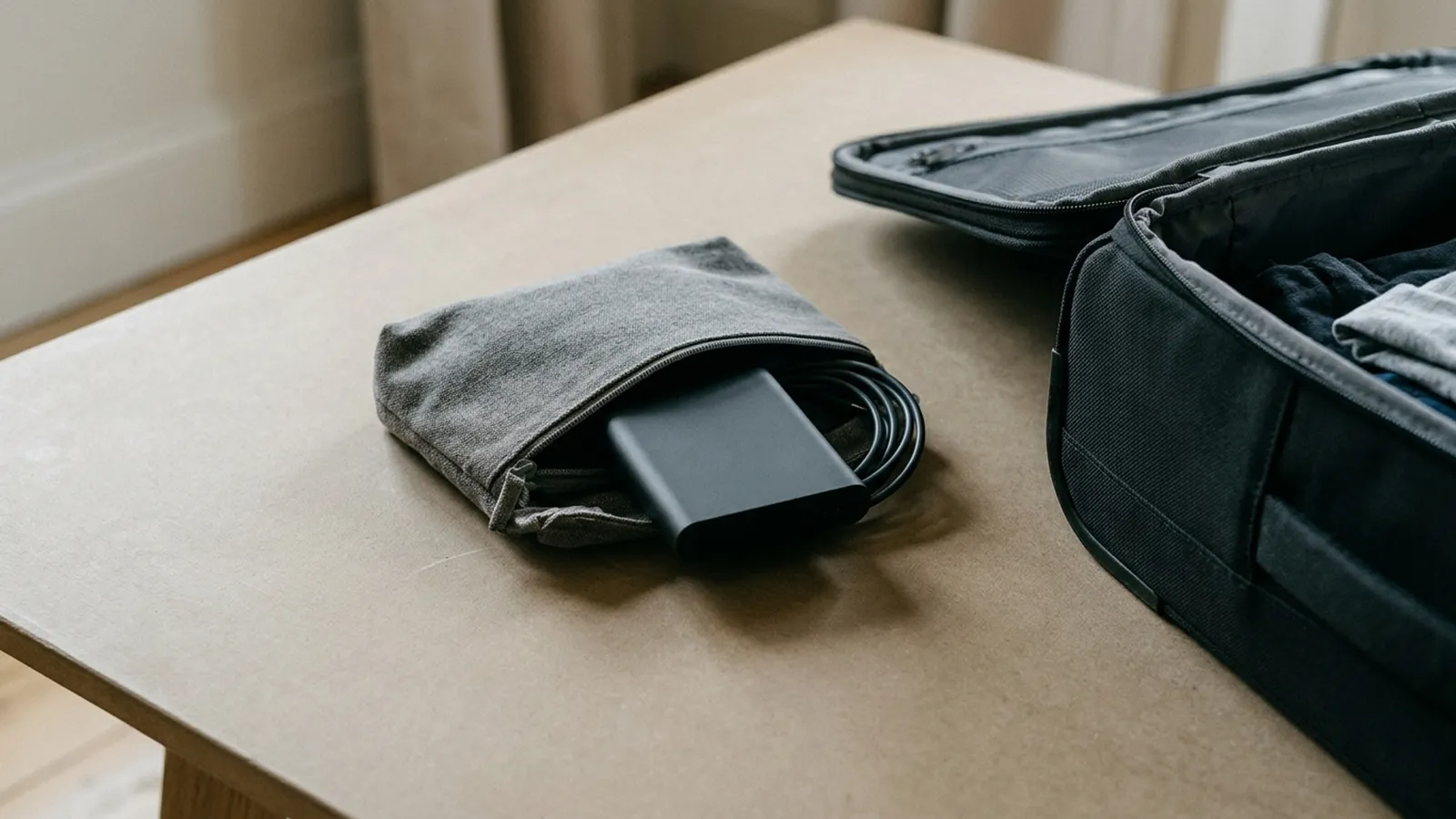
A small portable charger can create a packing problem at the last moment. You planned to carry a suitcase into the cabin, but the airline asks to check it at the gate. The power bank inside has not become suitable for the hold because the bag has acquired a tag.
The useful preparation is to identify the battery, check the rules for the airlines actually flying you and keep it somewhere you can reach before handing over the bag. This guide concerns ordinary personal power banks, not mobility equipment or medical-device battery arrangements.
Find the rating before packing
Look for the watt-hour rating, written as Wh, on the product. Photograph the label for your own records, but keep the original label legible. A product name or a large capacity number in advertising is not the same as the information the airline needs.
The FAA’s passenger battery guidance, checked November 17, 2026, places ordinary lithium-ion batteries up to 100 Wh in its permitted size category; larger batteries through 160 Wh require airline approval. It also warns that airline and international restrictions can be tighter. That is a US starting point, not permission for every product on every itinerary.
If the rating is unclear, resolve it with the manufacturer and operating airline before departure. Do not assume that a security officer will accept a screenshot of a marketplace description as evidence. Nor does a charger that worked on a previous trip necessarily meet a different operator’s current rules.
For an itinerary sold by one airline and flown by another, our codeshare guide explains how to identify the operator. Check the relevant carriers for every flight rather than stopping at the seller’s baggage page.
Make the charger easy to remove
Pack the power bank with the small items that stay with you if a larger cabin bag is checked. An accessible pouch is more useful than a charger buried beneath clothes at the bottom of a suitcase.
The FAA says spare lithium batteries and portable chargers belong in the cabin, must remain accessible and need protection against damage and short circuits. Its battery baggage summary, checked November 17, 2026, expressly says to remove them when a carry-on is checked at the gate or planeside.
In an invented example, a traveler has a roller bag and a small shoulder bag. The roller contains the clothes; the shoulder bag contains the permitted charger, documents and essentials. When the roller is taken at the gate, the battery is already with the passenger. The practical advantage is less rummaging while other people wait to board.
Protect the battery and its terminals using the manufacturer’s packaging or the FAA’s described protective measures. A loose device mixed with keys, crushed inside a bag or showing damage is a different proposition from an intact, properly protected charger.
Separate carrying it from using it
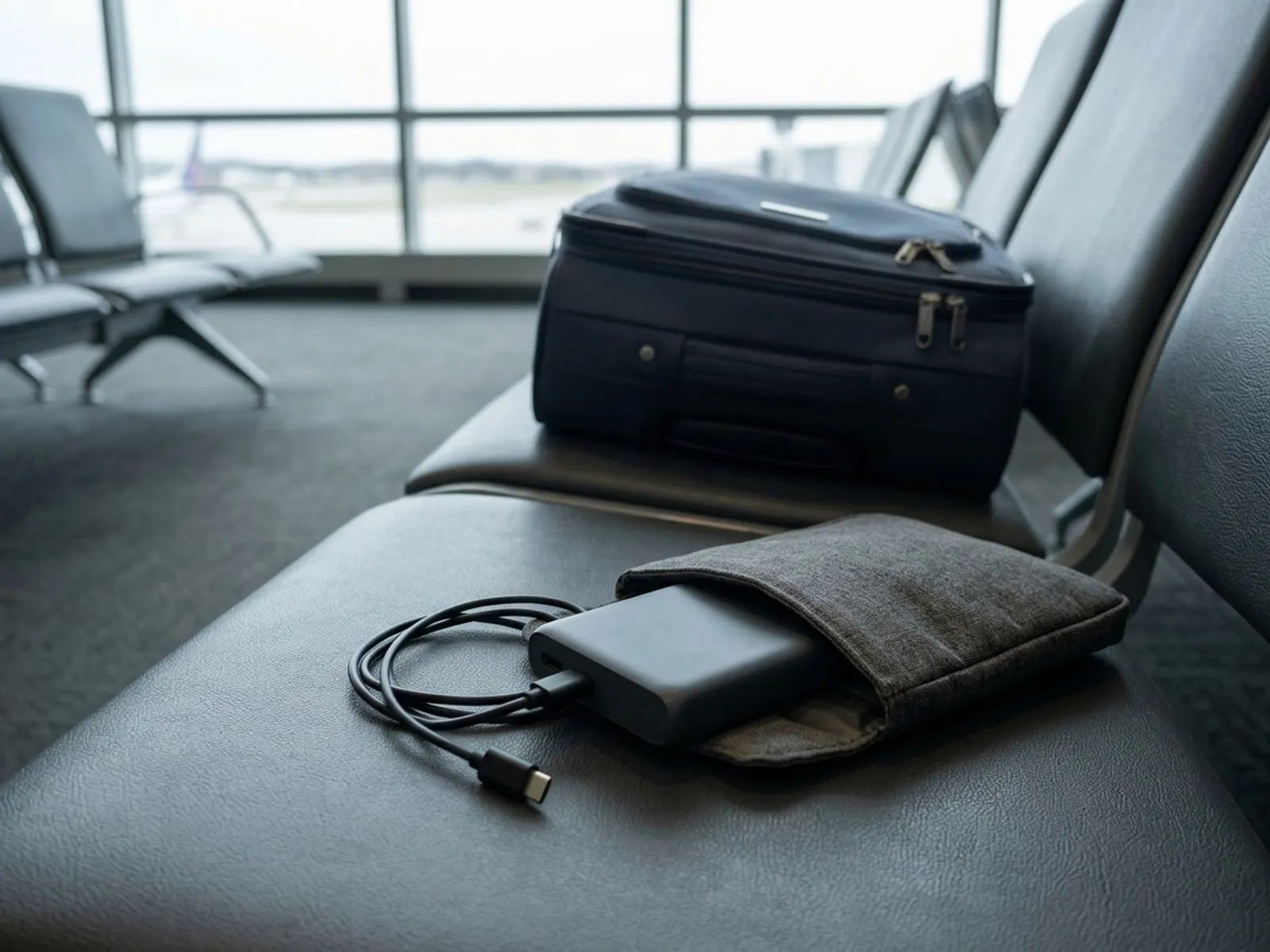
An airline may permit a battery in the cabin while restricting its use or storage during flight. “Carry-on only” therefore does not automatically mean “plug it in whenever you like.”
Singapore Airlines’ restrictions, read November 17, 2026, provide a concrete example: its power-bank instructions prohibit use and charging during the flight and say not to store power banks in overhead compartments. Those are that airline’s published instructions, not a universal description of all carriers.
Before leaving home, check carriage, quantity, approval, storage and use as separate questions. If a connection changes the operating airline, revisit the answer. Follow the crew’s instructions on the aircraft even if your packing plan began with a different carrier.
Charge the phone before departure where practical, and download what you need. TravelTutor’s offline trip-folder guide helps reduce dependence on having a working connection or a charger immediately after landing.
Recheck before handing over the bag
If staff ask to check your cabin bag, pause before it leaves your possession. Tell them you need to remove a power bank and any other items they instruct you to retain. A familiar packing routine can be interrupted by an aircraft change or a full cabin.
Do not rely on whether the bag will be returned at the aircraft door or the baggage carousel. The immediate issue is where the battery will travel, not where the suitcase will later reappear.
Our bag-transfer guide covers the onward handling question. For the power bank, establish the cabin arrangement before the suitcase is taken away. If you are unsure about an item, ask staff rather than quietly leaving it inside.
Leave damaged products out of the plan
The FAA warns against carrying damaged, defective or recalled lithium batteries that present a safety concern. Check a questionable product with its manufacturer and airline before travel; replacing a travel accessory is a separate decision from trying to persuade staff to accept it.
If a device becomes unusually hot, expands, smokes or burns on board, notify the cabin crew immediately. Do not hide it in a bag or wait to see whether the problem disappears. This is a situation for the crew’s procedures, not improvised instructions from a travel article.
The aim is a simple, repeatable habit: identify the permitted charger, keep it protected and accessible, and check again whenever the bag’s destination changes.
Common questions
Does switching a power bank off make it suitable for checked luggage? No. The FAA treats power banks as spare batteries, which must remain in the cabin. That is different from rules for a battery installed in an electronic device.
Can I take the same number on every airline? Do not assume so. Operator and international restrictions can be stricter than the US baseline. Check the actual itinerary.
Can I use it as soon as I sit down? Check the operating airline’s current rule and follow crew instructions. Permission to carry a charger does not settle permission to use it.
Sources checked November 17, 2026: FAA passenger battery guidance; FAA baggage summary; Singapore Airlines baggage restrictions.